
Major technological advances
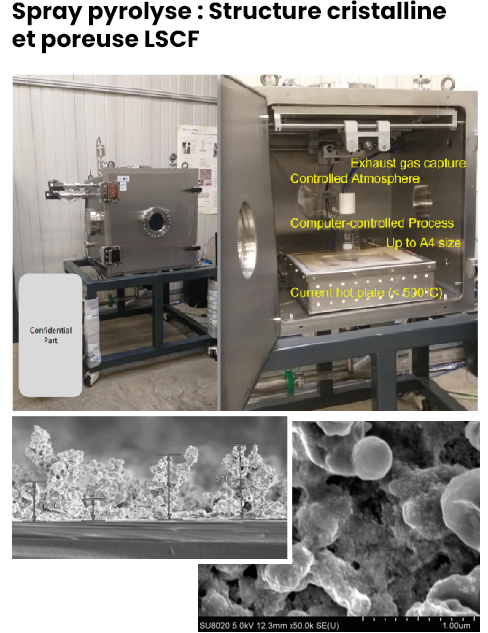
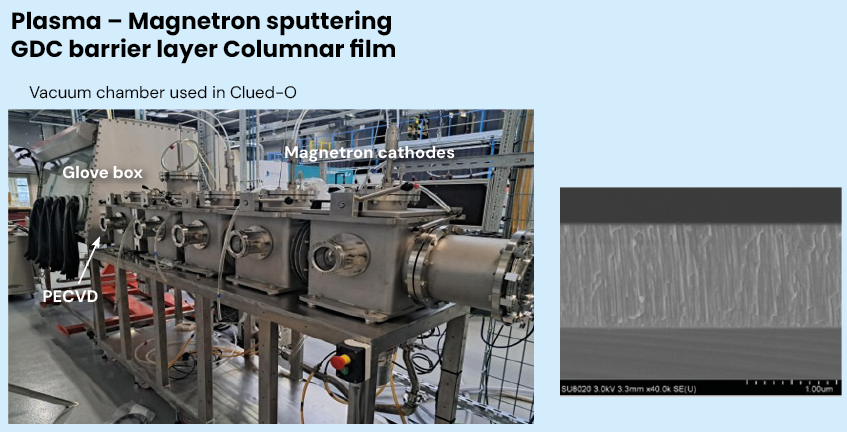
We have reached a key milestone with the development of the first LSCF/GDC layers via spray pyrolysis, which exhibit a dendritic morphology with a high specific surface area and a crystalline structure following heat treatment. In parallel, the first GDC barrier layers were produced using magnetron sputtering, resulting in a dense, columnar morphology with a crystalline structure.
We have also strengthened our experimental capabilities by acquiring a Fiaxell SOFC test bench, which allows us to study cell performance and stability over time. Finally, a life cycle assessment is currently underway to evaluate the overall environmental impact of the technology being developed.
3D printing of nickel current collectors
An initial material based on metallic nickel has been formulated and is already suitable for use in 3D printing (pellet-based additive manufacturing) to produce architectured anode current collectors. Alongside the optimization of this material, the printing and sintering parameters must now be defined.
Laser texturing of YSZ ceramics
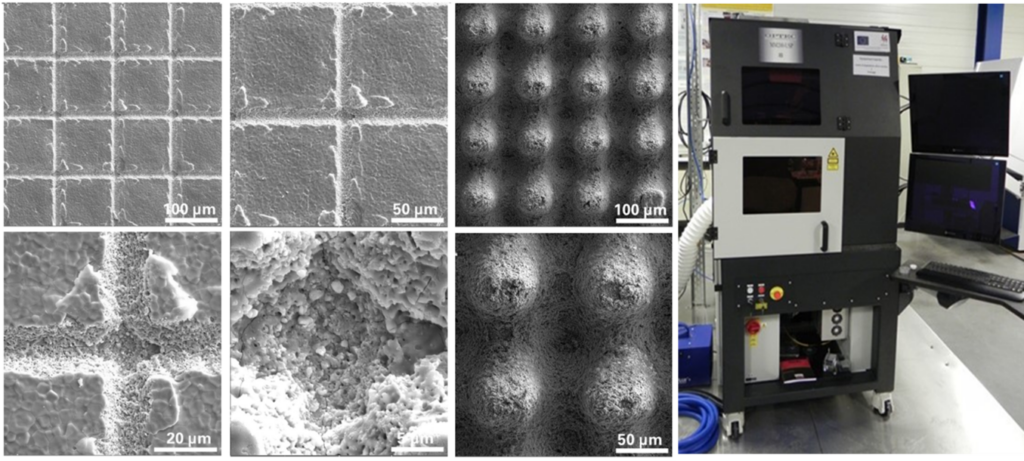
An initial set of parameters has been identified for the laser ablation and texturing of YSZ ceramics (Figure 1). Grooves with a depth of 5 µm were produced on the thin, dense YSZ ceramic layer of commercial half-cells using a femtosecond laser source. By employing a nanosecond laser source, the depth of the grooves in YSZ strips—prior to sintering—could be adjusted to between 10 and 100 µm. These preliminary results are highly promising and suggest the potential for a significant increase in the contact surface area between the electrolyte and the cathode.
Fast-Track axis : optimization of interfaces and cathodes
Mastery of barrier layers: three GDC solutions have been synthesized via the sol-gel route. Adjusting their viscosity now allows for precise control over the thickness of the deposits (from 2 to 20 µm) using spin-coating and dip-coating processes.
Fabrication of symmetrical cells: numerous cells were produced to evaluate the impact of cathode architecture on performance. Initial depositions of bulk LSCF cathodes via screen printing and impregnated GDC structures were successfully carried out on YSZ pellets.
Next step: optimizing the sintering process and sending the first cells to Centrale Lille for characterization via impedance spectroscopy. ULCO will also test these coatings on laser-textured pellets provided by CRIBC.
.
Slow-Track axis : development of the anode on a metal substrate
Anti-corrosion treatment: the impregnation of the FeCrAl metallic substrate with an LNF solution has been optimized. This treatment effectively protects the substrate against oxidation at high temperatures (up to 800°C in air) while improving its electrical conductivity.
Substrate densification: uniaxial pressing studies are underway on thicker (1.4 mm) FeCrAl substrates supplied by Bekaert, with the aim of reducing fiber porosity and increasing structural rigidity.
Development of the functional anode: the synthesis of pure NiO powder via the sol-gel process has been completed, enabling the formulation of NiO inks and the NiO-YSZ cermet (65% NiO – 35% YSZ). These inks will be applied via screen printing and optimized to ensure low surface roughness—a prerequisite for the subsequent deposition of the thin-film electrolyte.
Innovative recycling using molten salts
Validated scientific foundations: the materials used in SOFC cells have been cataloged, and the most suitable molten salt baths for recovering critical elements have been identified.
Launch of experimental trials: experimental protocols for testing and analysis have been defined. Initial reactivity tests have begun on individual oxides and metals (ZrO2, NiO, Y2O3, CeO2, etc.), as well as on commercial half-cells from the Fast-Track project.
Energy optimization: various families of reaction baths (chlorides, carbonates, nitrates, sulfates, hydroxides) have been selected. The choice focuses on the lowest possible melting temperatures in order to minimize the energy consumption of the future process.