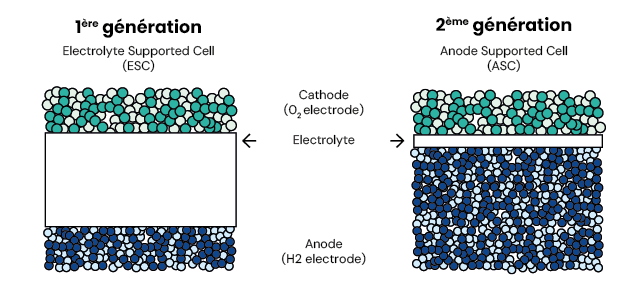
1st generation In this initial version, the electrolyte (the central layer) is very thick, serving as a solid support for the cell. A drawback is that this thickness hinders the flow of current (ohmic losses) and requires the system to operate at very high temperatures (over 800°C).
2nd generation To lower the temperature (to between 700°C and 800°C) and reduce energy losses, the electrolyte has been refined. The anode now serves as the thick, mechanically supportive component. This, however, requires a highly optimized internal structure to allow for the efficient circulation of gases.
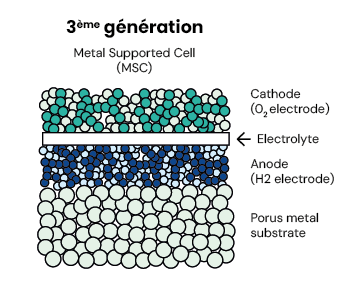
3rd generation This technology is at the heart of our project! The substrate is a neutral, porous metal, which allows the three active layers (anode, electrolyte, cathode) to be made as thin as possible. The result: a more stable cell that operates at an even lower temperature (below 650°C).